
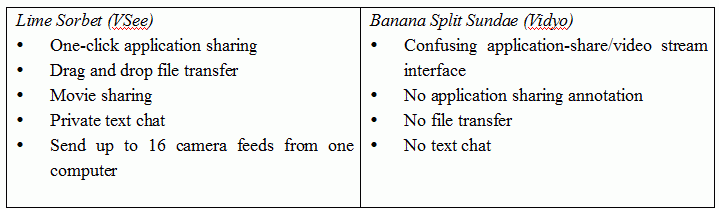
I love banana split sundaes, but I might not want to eat one after a five-course meal. A refreshing lime sorbet might be a better way to top off my meal excesses 🙂 Likewise videoconferencing solutions should be light and refreshing. VSee and Vidyo both deliver multi-point HD telepresence video, but like the lime sorbet, VSee is light and refreshing while Vidyo is unnecessarily complex. Here’s a closer look:
#1 Rich Collaboration
VSee is about video plus getting work done, while Vidyo is focused on room-to-room meetings.
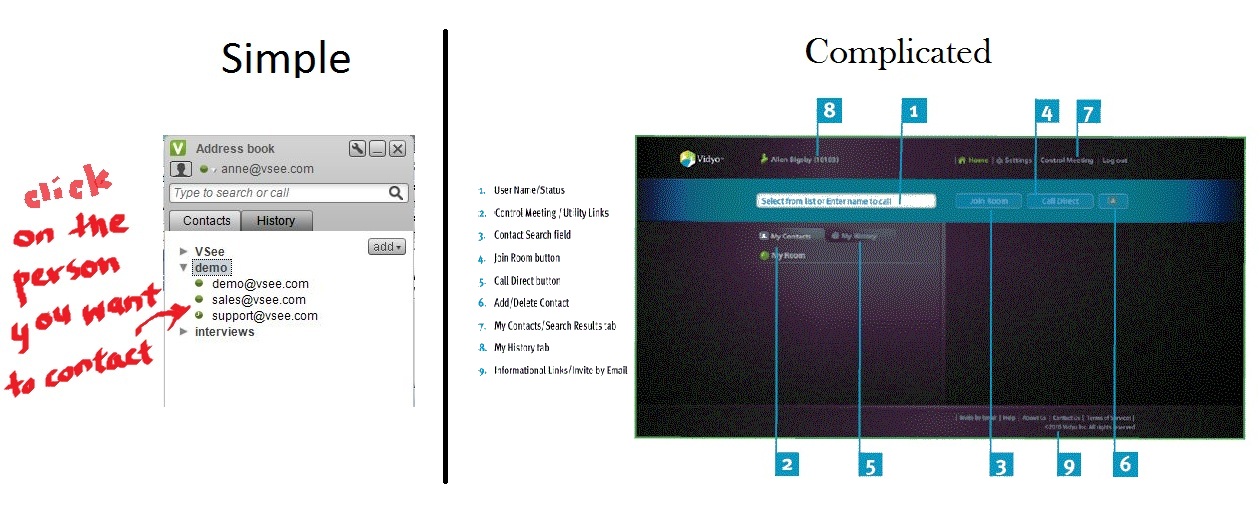
Like minimalist architect Mies van der Rohe, VSee has adopted “less is more” as our design motto. VSee cares deeply about the user experience, and our interface minimizes the number of clicks needed to do something. In fact it is sometimes easier to “grab” the people you need using VSee than if you were working in the same office. Unlike Vidyo, there is no need to log into a separate web portal, e-mail links, or create a meeting. Just click on the name of the person you want to see and start working. Stuck halfway through? Click again and bring in another colleague who has the answer.
Vidyo is more suited for scheduled meetings and presentations. A Vidyo user is assigned a private “room” and controls when the “room” will be used, who is allowed in the “room” and what kind of privileges attendees can have. Getting people into a meeting usually requires sending out invitation links, which makes it a little more convenient to bring in Vidyo guest users. During a meeting individual users can choose from a nice selection of window layouts to display the video faces. However, if the host needs to leave the “meeting room,” then the party is over.
If you don’t want to take my word for it, you can check out VSee and Vidyo’s “how-tos.”
#2 Scalability

VSee is like a well-mannered house guest when it comes to your network, staying at your house and using your resources only as long as he is invited. This makes it easy to adapt VSee to your existing network infrastructure with few changes or upgrades. It also means that VSee performs well even over cellular 3G wireless networks. Vidyo’s client-server architecture, on the other hand, makes it a resource hog that requires a lot of servers and dedicated network resources.
When VSee and Vidyo is set at the same video quality, VSee requires significantly less bandwidth. This is why VSee has rapid growth in emerging markets such as Africa, the Middle East, and India.
#3 Security:

VSee is endpoint-to-endpoint encryption, which means information is sent through a dedicated tunnel directly from your computer to the other person’s computer without any sort of server middleman transfer. Vidyo’s use of https, means their servers have access to your streams. Also the use of different ports for different media, rather than a single port, leads to more leaking of information.
Some Other Reviews:
TelBitConsulting blog’s rave of Vidyo
Brandontek’s more toned down review of Vidyo
A gamer’s completely unprofessional blurb on using VSee
You might also be interested to read our article here: VSee – Free Alternative to Vidyo Telepresence Business Video Conference – Comparison
Follow us on Twitter (@VSee) and Like us on Facebook to hear about the latest from VSee! By the way, we are hiring too.


Thanks for linking to my “ancient” VidyoDesktop review! 🙂
hi Mike,
hopefully you can do an updated Vidyo review 🙂 we are getting vidyo customers everyday – most recently this morning someone in Switzerland said Vidyo is inadequate because:
1. requires administrator permissions to install the client
2. is a CPU hog
3. poor performance over 3G or any time the network is used by other applications
4. complicated user experience – it is designed by a business major, and not someone who understands communication
hopefully you can do an independent re-match of vsee vs. vidyo 🙂
Milton