Boosting Provider Efficiency 93% with AI Documentation
Updated :
August 26, 2025
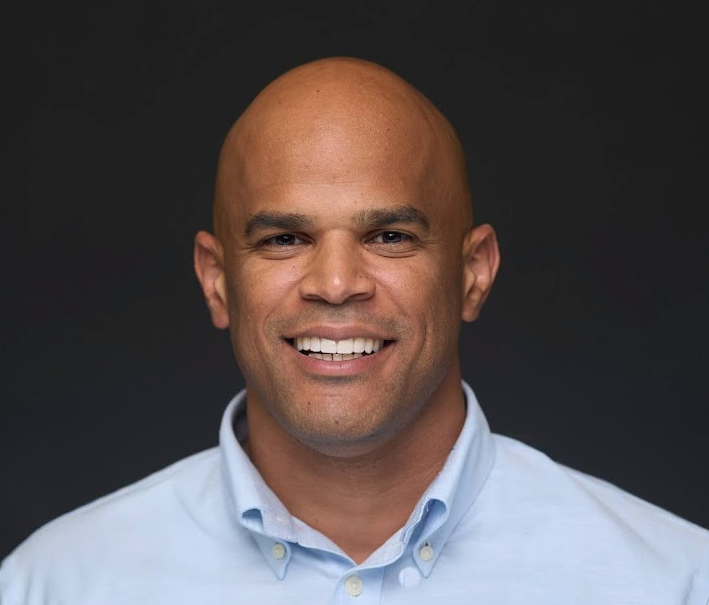
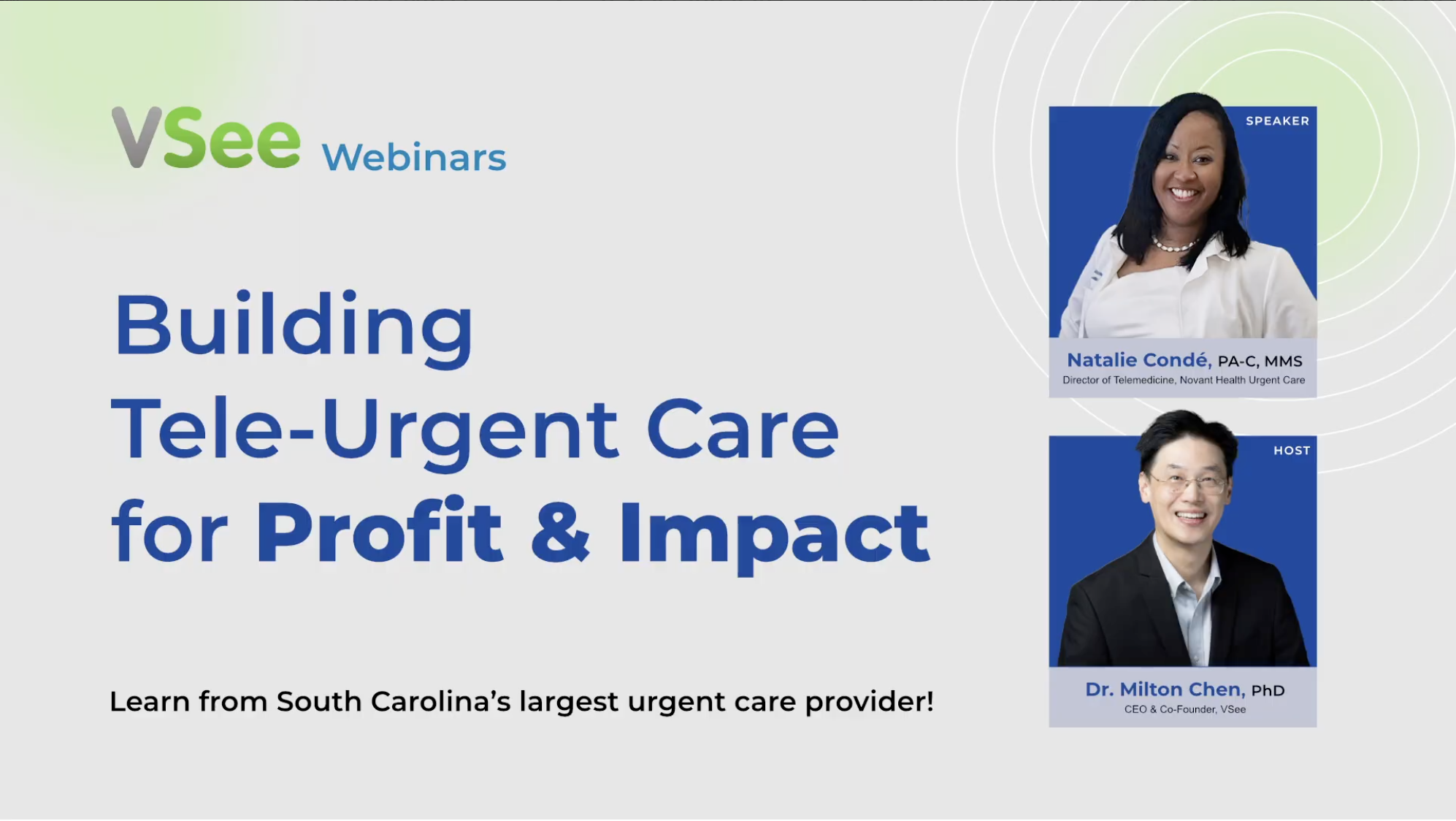
Big thanks to our speakers, Dr. Ramon Lizardo, MD (Tele911 CEO), and Dr. Milton Chen, PhD (VSee CEO), for sharing their story of how VSee’s platform is making it possible for Tele911 to handle 10 million virtual visits each year. This webinar provides a grounded look at the day-to-day realities of integrating AI into practice, the ongoing burden of paperwork, and how VSee’s solution is allowing Tele911 place provider focus and patient care back at the center.
AI Doctor Notes Work Transformations Discussed
Spend Almost Zero Time Taking Notes – 15 Minutes down to 1 Minute per visit: Tele911’s AI-driven note-taking tool reduced documentation time per patient from 15 minutes to just 1 minute. This gives back to providers up to 14 minutes for every visit, allowing more time for patient care and reducing administrative burden.
Patient-Focused, Hands-Free Visits: With AI handling all the note-taking and repetitive typing, clinicians can now focus their attention solely on the patient, eliminating the need to divide their attention between the patient and note-taking. As Dr. Lizardo shared, “Our doctors can now give each patient their full attention, making appointments feel more personal and connected.” This leads to improved care experiences and a less stressful workday.
More Complete and Reliable Patient Records: AI-generated notes are more accurate and thorough, reducing the risk of missing important information and ensuring everyone has clear, reliable records.
Easy to Use and Quick to Set Up: VSee’s AI Notes was quickly rolled out across Tele911’s virtual ER. It fits easily into existing workflows and can be adopted without major disruption or extensive retraining.
Ongoing Innovation and Collaboration Dr. Chen stressed the importance of feedback and adaptation. “We constantly iterate and improve these tools based on real-world clinician input, because every minute matters, for both the patient and the provider,”
VSee AI Doctor Notes Product Questions Addressed
Customization & Clinical Flexibility
“For psychiatry, can there be a custom note? For example, having a mental status exam or can we customize the SOAP note for this specialty?” Yes! VSee’s AI Doctor Notes solution supports notes customization. If a specific structure or template is required (such as for psychiatric evaluations or other specialties), users have the choice to implement the template they need, supporting flexible clinical documentation.
Platform Features & Usage
“Does VSee have AI dictation built into its platform?” Yes! VSee’s AI Doctor Notes are directly integrated into the VSee Clinic platform and may be turned on by request. It can also be used as a standalone solution with virtual or in-person visits.
“Does your AI 'scribing’ happen in real time, or does it depend on having recordings?” The AI Notes solution records the visit and then transcribes it.Clinicians may then generate their desired note structure (e.g., SOAP) from those transcripts, allowing for flexible workflow adaptation.
“Doesn’t recording require patient consent? This is where we have a bottleneck.” Patient consent is built into the VSee intake workflow, so it is automatically captured before a patient talks to a provider. We recommend integrating consent into standard HIPAA forms that every patient already signs at the doctor’s office. In the Tele911 workflow, instead of requiring separate agreements or checkboxes, patient consent is directly captured on video, as well as the transcription. This digitized, “one-click” approach eliminates extra steps, making it much faster and easier for both patients and providers to complete the consent process and continue with care
“Can the transcription be inserted into another EHR ...for example.. EPIC? or others? that may have different sections?” Yes! The solution is designed with adaptability in mind, making it feasible to insert transcribed and structured notes into various EHRs, even those with differing section templates.
Other Top Attendee Questions Discussed:
Integration & EHR Accessibility
“How do you address the EHR accessibility and multiple database connectivity challenges?” The speakers recognized that integration with different EHR systems and addressing database connectivity can be bottlenecks, but indicated these are solvable problems. Over time, advancements in AI will enable smoother and more scalable integration with a variety of EHR platforms, including widely used ones like EPIC and others that may have different section structures. The vision is that, soon, most interactions with EHRs will be AI-driven, streamlining documentation across systems. VSee’s platform currently integrates with Epic, Oracle (Cerner), and other major EHR systems via FHIR, HL7, CDA, other open protocols and proprietary APIs.
Security & Compliance
“At the health plan level, health plans are hyper-focused on database security. There have been several data breaches, which are causing challenges in accessing that data. Can you discuss at a high level what security levels that are being utilized in the solution?” To address health plan concerns about database security, the solution uses multiple layers of protection, including rigorous external audits. Key security certifications such as SOC 2 and HITRUST (often referred to as HiTrust or HiTrust CSF) are emphasized as essential, since they verify robust security measures through third-party assessment instead of relying solely on claims from the provider. Achieving these certifications not only reassures health plans following recent data breaches but also establishes trust and credibility with partners. This approach makes it easier to work with over 140 health plans, as well as major organizations that prioritize strict data security standards
“Should patients be explicitly informed when AI is used in their documentation or care process, and what level of detail is appropriate?” The speakers agreed that while concerns about using AI in patient documentation were more prominent in the past, today’s patients are increasingly aware and even expect that AI might be used in their care. Transparency remains important: patients should be informed when AI is involved, but most care more deeply about how their information is kept secure and used responsibly. The panel emphasized that strong security and HIPAA compliance are critical regardless of AI involvement. Ultimately, the speakers felt that patient consent for AI use won’t be a major bottleneck, as AI becomes a standard, trusted part of healthcare workflows. They also stressed that AI should be used to empower—not replace—clinicians, with the goal of improving outcomes and the patient experience.
AI-powered scribing and telehealth innovations are setting a new standard for efficient, accurate, and patient-centered care. Now is the time to see how these solutions can work for your organization.
Ready to transform your practice? Contact our sales team here to schedule your one-on-one consultation. Our team at VSee and Tele911 is here to help you take the next step towards a more streamlined and effective healthcare operation.
Image Gallery
No items found.
Slides
Speaker
Ramon Lizardo, MD, MBA, is a digital health executive and the CEO of Tele911, a venture-backed company revolutionizing emergency medicine through AI. With a background in clinical innovation, value-based care, and healthcare operations, Ramon has scaled solutions that improve access, reduce costs, and transform patient outcomes. He brings a unique blend of medical expertise and entrepreneurial drive to discussions at the intersection of AI, healthcare delivery, and system redesign.
Dr. Milton Chen is the CEO and cofounder of VSee, the telehealth company born in the visionary Stanford University Human Computer Interaction (HCI) Lab, where Dr. Chen completed his PhD on the psychology and social factors of video communication, co-authored the XMPP video standard, and coded the prototype VSee system. Today, VSee serves 1000+ organizations worldwide, including McKesson, GE Health, Optum, DaVita, and NASA Space Station.