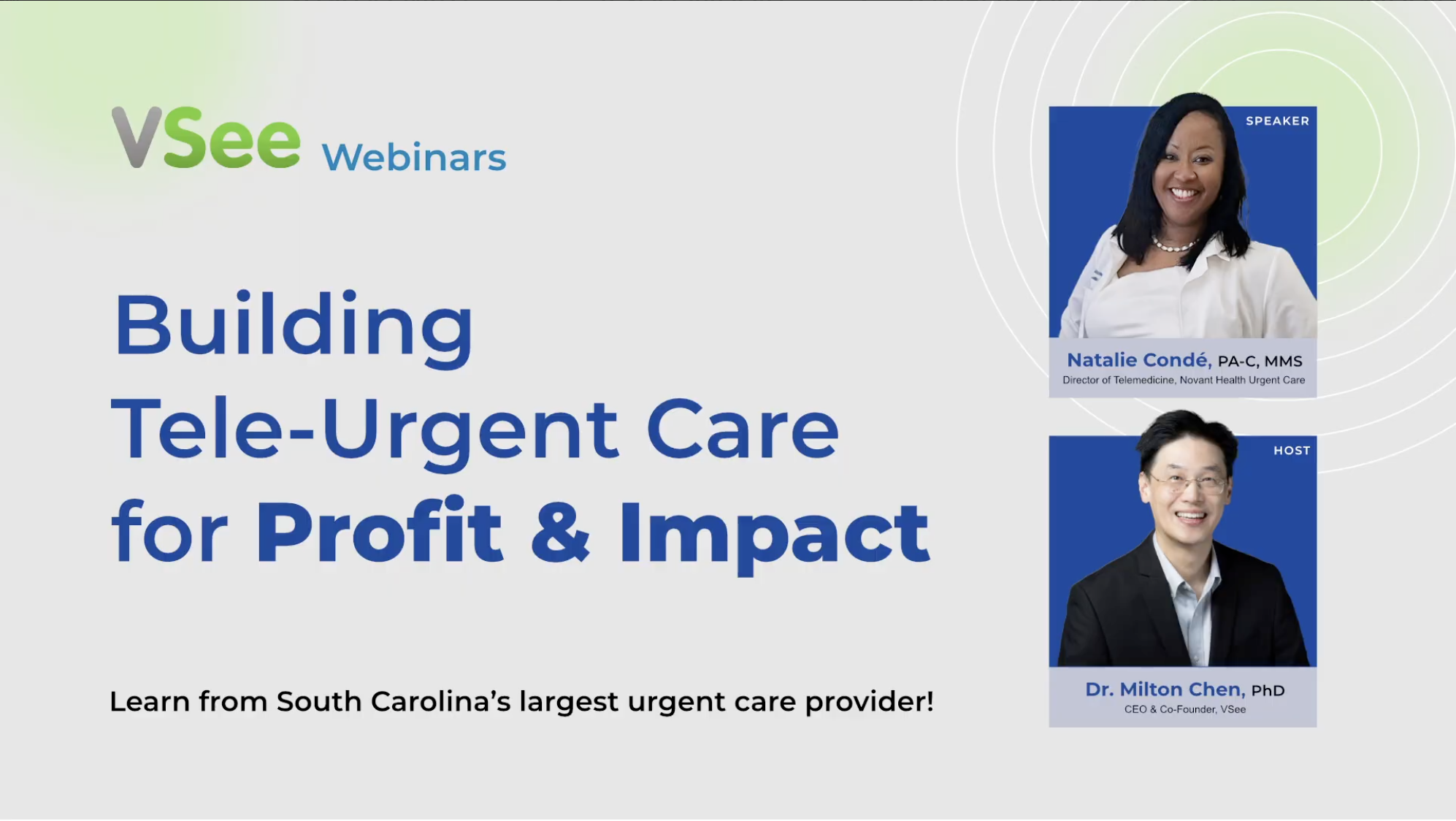
This webinar highlights how Novant Health, South Carolina’s largest urgent care provider, partnered with VSee to build a statewide tele‑urgent care program that improves access, supports rural communities, and strengthens clinic operations.
Guest Speaker: Natalie Conde, PA‑C, has over 16 years of healthcare and leadership experience and oversees Novant Health’s statewide virtual care platform, where she supports operations, provider workflows, compliance, and quality. The session walked through how Novant scaled virtual urgent care across 50+ clinics and what other organizations can learn from their approach.
Timestamps for the Webinar Recording
00:00 — Welcome & introductions
02:20 — Tele‑Urgent Care: What It Is & Why It Works
07:39 — Low‑Acuity Visit Types Ideal for Virtual Care
08:34 — How Telemedicine Supports Clinics During Surges
10:21 — Rural Access and Geographic Expansion
11:27 — Training Strategy That Drove System‑Wide Adoption
13:20 — Telehealth ROI and Sustainability
17:29 — The Future: AI, Diagnostics & Virtual Hubs
20:26 — High‑Value Q&A
54:47 — Closing Insights
Below are the specific steps that made Novant’s tele‑urgent care program successful.
Novant began by defining a clear visit strategy: telemedicine should handle low‑acuity, predictable conditions that don’t require hands‑on exams. This created an immediate foundation for scale.
Novant routed these visit types to telemedicine:
This moved large volumes of routine visits online, freeing clinics to focus on higher‑acuity patients.
One of the biggest drivers of adoption came from necessity. During flu, COVID, and strep surges, Novant used virtual urgent care as a pressure valve to keep clinics functional.
Tele‑urgent care allowed Novant to:
Proving telemedicine’s value during peak volume seasons set the foundation for long‑term, system‑wide use.
Scaling wasn’t just about clinic load management; it was about extending care.
Many Novant patients live 30–45 minutes from the nearest clinic. Virtual visits made care accessible for rural families who otherwise struggled with distance, transportation, or clinic availability. Telemedicine served as triage and treatment, depending on the patient’s needs.
Natalie personally visited all 50+ clinics to train staff on how to use the platform, what visit types are appropriate, how to onboard patients, and how virtual and in‑clinic workflows connect.
This hands‑on approach:
And with VSee providing rapid updates, staff stayed supported and the system stayed stable.
Novant made telemedicine part of its everyday clinical workflow. This integration made long‑term scaling possible.
Telemedicine now contributes to:
What is the best way to increase tele‑urgent care adoption?
On‑site training. Staff hesitation disappears when leaders show up in person to demonstrate workflows, answer questions, and remove the fear of new technology.
What are some effective ways to reach underserved populations?
Partner with churches, community centers, and local organizations; use outreach methods (mailers, social posts); make joining the platform simple—web browser access works best for seniors.
How do you stay competitive with low‑cost telehealth competitors?
Focus on high‑touch, relationship‑based care, fast response, and community trust. Quality and consistency outperform transactional “quick‑prescription” models.
Can tele‑urgent care manage chronic conditions?
No—only bridge refills. Long‑term management must remain with primary care for continuity and safety.
How can you ensure privacy when using AI tools?
Every tool must undergo full IT, HIPAA, security, and EMR integration review before implementation—no exceptions.
For Novant Health the right technology partner has been essential for sustaining and growing their operations through the many changes in the market and in its business (e.g. COVID-19, payer partnership, acquisition).
VSee has allowed Novant to refine its patient journey through rapid, deep customizations. VSee’s platform allows Novant to tailor online intake forms for specific patient flows—such as dependent account creation and wellness device data uploads. It also allows Novant to streamline its clinician workflows with tailored documentation templates or patient status tagging for efficient handoffs.
As Novant Health looks towards the future, VSee is ready to support any new features it may require. Ideas for capabilities expansion include:
Whether increasing clinician remote capabilities, simplifying patient experiences, or improving administrative abilities, VSee’s secure, flexible platform offers the infrastructure and AI modules organizations need to expand their virtual care capabilities whenever they are ready to take the next step.
See how VSee can help your organization expand access and strengthen urgent care delivery. Request a live demo today.