VSee Virtual Assistant
Icon Rounded Closed - BRIX Templates
Home
>
Blog
>
VSee for Disaster Relief: Supporting Critical Hospital Operations Post-Cyberattack
ON-DEMAND WEBINAR

VSee for Disaster Relief: Supporting Critical Hospital Operations Post-Cyberattack

Updated :
September 18, 2025

Image Gallery

No items found.

Slides

Speaker

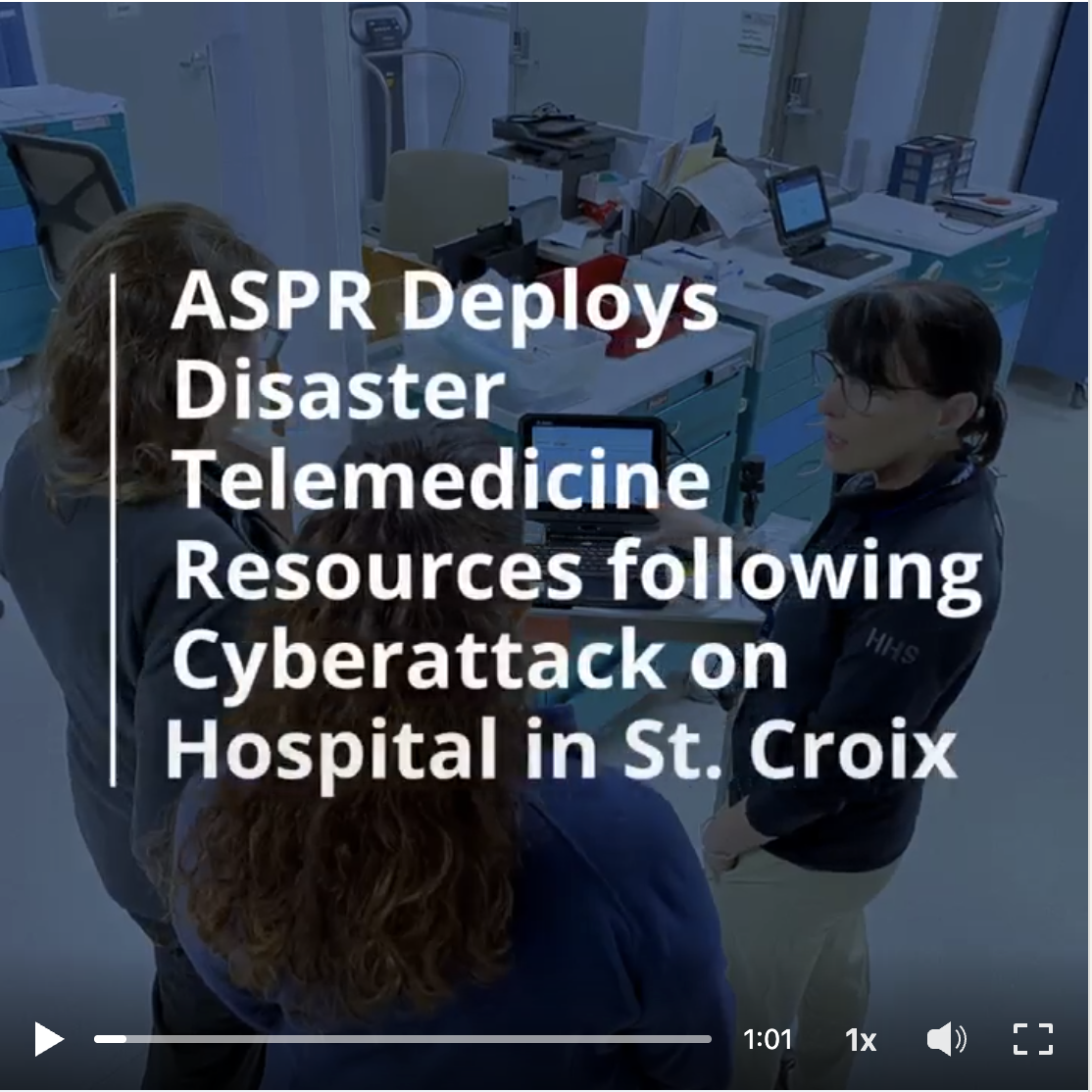
When a catastrophic cyberattack crippled key IT systems at the Governor Juan F. Luis Hospital and Medical Center (JFL), including radiology services, VSee’s telemedicine disaster platform played a key role in keeping vital patient care going.  In just two weeks, the VSee team deployed a custom-configured platform that enabled JFL to speed its recovery efforts, allowing it to clear its radiology backlog and providing 24/7 connectivity to remote specialists for emergency care.

Key Outcomes for JFL

  • Disaster recovery platform customized for radiology and on-demand specialist consults deployed in 2 weeks
  • 250+ radiology studies processed, clearing its backlog 
  • <1 hour turnaround for emergency imaging reads delivered
  • Teleneurology consults that lead to 2 emergency off-island transfers
  • Continuity of high quality patient care without overstraining staff and IT

Who Was Involved in the Disaster and Relief Efforts

Governor Juan F. Luis Hospital and Medical Center (JFL) is the main hospital on St. Croix island of the U.S. Virgin Islands; it’s also the only hospital

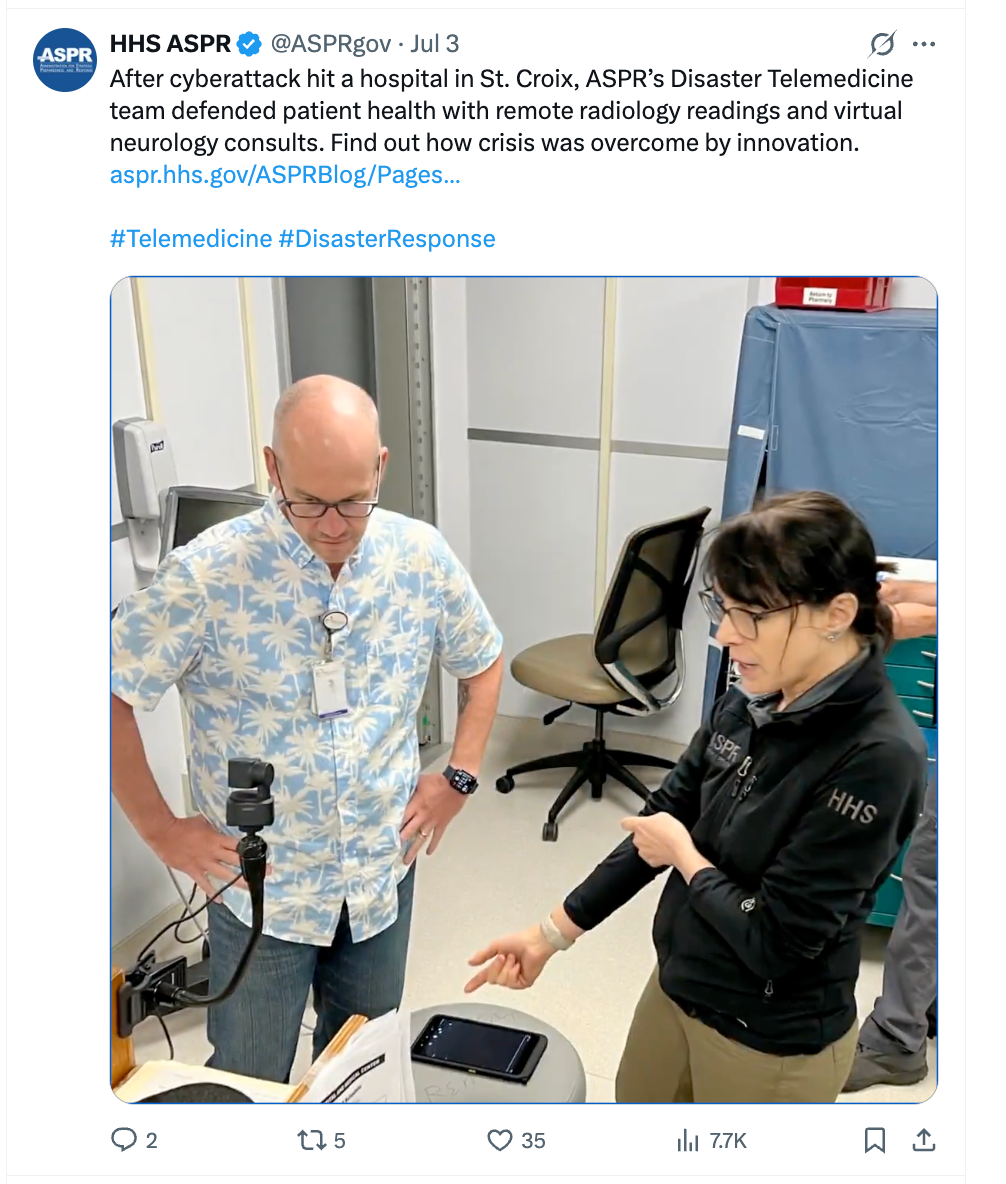
U.S. Department of Health and Human Services (HHS) Administration for Strategic Preparedness and Response (ASPR) was contacted by JFL to assist in keeping its strained hospital operations going. The ASPR team provided planning experts and telehealth resources. 

VSee – The digital health platform partner of HHS ASPR, who designed and created ASPR’s customizable integrated Telemedicine Disaster Response System that enabled remote medical support tailored to JFL’s situation. 

What Happened at JFL?

A cyberattack incident on April 26, 2025 left JFL with limited access to key IT systems — including radiology—which began creating a bottleneck in its patient flow. JFL already deals with understaffing issues, and the cyberattack put additional strain on limited team resources, threatening to halt its patient care services, specifically:
  • JFL clinicians were unable to access or share reports from imaging archives (to access an image, they had to physically walk down to where the machine was located)
  • Lacked access to specialist expertise for emergency care
  • Emergency transfers were being delayed
  • Diagnosis and treatment for critical patients were at risk

How VSee Supported HHS ASPR’s Disaster Telemedicine Response

HHS ASPR’s Telemedicine Disaster Response System is an integrated telehealth platform and a streamlined electronic medical record (EMR) platform for NDMS (National Disaster Medical System) and other providers.

Unlike other telehealth systems, it supports more than typical one-off urgent care consults. It offers a comprehensive standalone EHR with telemedicine workflows natively baked into the system so providers can truly provide on-going care remotely even for surgeries and traumatic injuries. In addition, the system’s no-code, low-code design allows it to be easily and quickly configured to fit the specific needs of a disaster relief mission, regardless of the location — a teleradiology system in the case of JFL 

Summary of VSee Platform for ASPR Capabilities:

  • No-code, low-code design allows fast configurability to the disaster mission. 
  • Comprehensive standalone EHR with real-time patient tracking, notes with templates, orders, eRx, discharge.
  • Native telemedicine workflows: secure video and voice, text chat, multiparty consults, command-center coordination
  • Integrated diagnostics: remote auscultation, EKG, vitals, CT, ultrasound, exam camera—captured in the encounter.
  • Security and compliance: end-to-end encryption, role-based access (provider, non-provider, etc.), audit logs, cloud redundancy.
  • Interoperability and custom reporting: HL7/FHIR exchange, incident/after-action reports, CSV exports; HIE support to pull existing patient records when available.
  • Scalable multi-state, multi-site deployment and coordination for pop-up clinics anywhere

VSee Solution Applied to JFL:

  • Secure Telemedicine Systems:
    • VSee software platform with end-to-end encrypted EHR, shared imaging archive, video calls, and remote medical device support 
    • HHS ASPR tablets with LTE failover
  • 24/7 Remote Specialist Access for Emergency Care:
    • Tele-radiologists from five states interpreted urgent images; remote neurologists and psychiatrists provided instant consults.
  • Restored Teleradiology Workflows:
    • Physicians could review imaging from any device and relieve local staff.

A Model for Future Disaster Readiness

With cyberattacks becoming more common, hospitals need more than standard IT tools. True resilience and patient access depend on unified, disaster-ready telehealth platforms like VSee.

JFL’s experience shows the lifesaving power of adaptable, secure telehealth systems, ready to operate when traditional IT fails. 

JFL CEO, Darlene Baptiste shared, our response “brought relief and benefit to our staff and patients.”

We’re proud to partner with ASPR and hospital teams nationwide to ensure patient care never stops.


Are You Disaster-Ready?

Don’t wait for a crisis to reveal your vulnerabilities.Contact VSee for a telehealth system that keeps care flowing, no matter what.


Get Access to 300+ healthcare leaders talks
UnitedHealth | Microsoft | BCBS | DaVita | Intel | Salesforce | Samsung | CEP | Intermountain | Cambia Health | Lyft | WorldBank | GE | & more
Watch Now -->
Share this: 

Related articles

Browse all articles